With scattered procurement requests, rogue purchases made outside of a company's established procurement process, and constantly changing compliance guidelines, negotiating terms of purchase for inventory or services can be exhausting. FluxAI Agents automate requests for quote (RFQs), bid comparisons, generating purchase orders, and curating vendor scorecards to keep teams focused on sourcing.
Procurement & Vendor Management Specialist
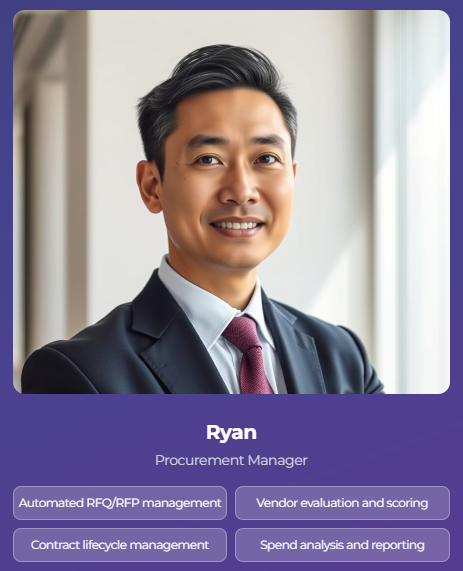
Today, we are introducing Ryan, an on-demand Procurement Manager who automatically contacts suppliers for service pricing, tracks their performance, and evaluates vendors with structured scoring.
Plugging directly into Procure to Pay (P2P), Enterprise Resource Planning (ERP), and Contract Lifecycle management (CLM) platforms, Ryan smoothens incoming purchasing needs, fetches competitive quotes, and determines risk signals to arrange terms, delivery timelines, and order quality. Ryan automates sourcing from request to renewal, and when negotiations stall, the workflow hands off the process to team members.
How Ryan Works
Step 1: A team member submits a purchase need outlining the scope of their required order, budgetary constraints, and deadlines.
Step 2: Ryan takes the order outline and compiles a list of vendors best suited to fill the order based on region, compliance, and historical performance.
Step 3: Once the list is created, Ryan automatically distributes RFQs to the selected vendors, who reply through an internal portal.
Step 4: Ryan then assesses vendor bids and flags any anomalous shipping terms or surcharges, scoring each quote against historical vendor performance data.
Step 5: Ryan sends the quotes off to the procurement team with a rationale for negotiations.
Step 6: The procurement team confirms quote clauses.
Step 7: Ryan converts approved quotes into purchasing orders and sends them to the selected vendors.
Step 8: Ryan continuously tracks deliveries and service level agreements, updating vendor scorecards with recent performance for renewals.
Application
To illustrate how Ryan works, let's consider the following scenario: it's Q4, and product teams are rolling out end-of-year adjustments. They need components from multiple regions, but accounting has tightened the procurement budget.
Ryan consolidates all incoming order requests in a unified queue and generates a list of suppliers with high performance scores in the regions where the product team is sourcing components. RFQs are issued, and as bids arrive, Ryan flags any discrepancies before passing them on to the rest of the team, along with the selected vendor scorecards to help in negotiations.
Once the procurement team approves a vendor, Ryan automatically generates a purchasing order, sends it to the supplier, and begins tracking performance and delivery. Suppose an order shipment is delayed or fails to meet a quality threshold. In that case, Ryan alerts procurement and logs the incident in the vendor scorecard, updating the performance score so the team knows not to order from that vendor again. Additionally, Ryan proposes corrective actions for incidents.
Conclusion
Sourcing products and services should be an informed and fluid process. As Ryan automates RFQs, bid analysis, purchase order generation, and vendor scorecards, significant time is saved, as teams no longer have to scour through vendor databases to identify a suitable supplier. Hire Ryan today to boost your procurement and explore our other FluxAI Agents for intelligent workflows to alleviate repetition across every industry.