CTOs, CIOs, and information system managers overseeing today's threat landscape have a lot to juggle. Between phishing, malware, ransomware, smishing (phishing via text), and other increasingly complex scams and attacks, cybersecurity experts are often on the back foot, reacting after vulnerabilities have been exposed.
Trying to balance alerts, fragmented systems retooling, conflicting C-suite priorities, and changing compliance standards has resulted in manual patchwork triage, corrective measures implemented after the fact, and slow response times.
Security should be a top concern for any software system. Now, with FluxAI Agents, teams can continuously monitor system integrity, correlate data more quickly, and accurately document threats, transforming reactive afterthoughts into proactive security insights.
Cybersecurity & Threat Intelligence Specialist
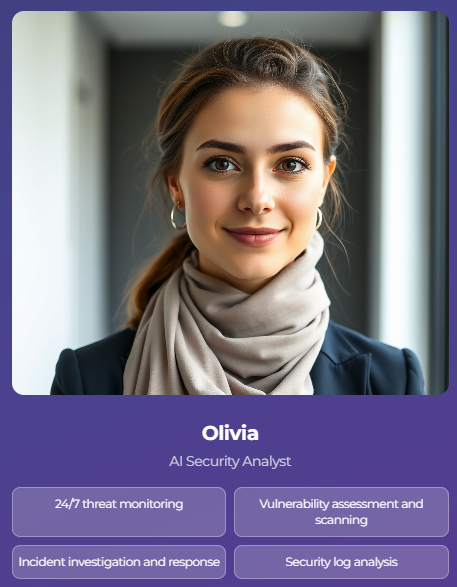
Allow us to introduce Olivia, a Security Analyst who automates threat detection, monitors security logs, and performs vulnerability assessments so that teams maintain compliance. Olivia is an intelligent workflow that integrates directly with any existing stack, regardless of setup.
Olivia integrates with threat intelligence feeds, Security Information and Event Management (SIEM) platforms, and Security Orchestration, Automation, and Response (SOAR) engines to automate processes for managing security risks across detection, investigation, remediation, and reporting.
How Olivia Works
Step 1: Olivia taps into a company's SIEM and ingests security events to spot suspicious activity as it arises.
Step 2: Olivia enriches incoming signals with threat intelligence and metadata context from past events, parses company security artifacts, and identifies likely attack vectors.
Step 3: Olivia uses behavioural patterns to group threat signals for related suspicious activity.
Step 4: Grouped signals are scored based on their severity of system impact; the larger the threat, the higher the score.
Step 5: Olivia passes signals with high severity scores to the security team for their attention and action.
Step 6: FluxAI agents are designed with human check-in points during the workflow's execution. Here, a human security analyst investigates the high-severity signals Olivia detected, reviewing event timelines and threat context to determine next steps.
Step 7: The analyst approves threat containment strategies, and Olivia then automatically executes countermeasures.
Step 8: Olivia begins remediation, patching vulnerabilities, and reconfiguring system orientation.
Step 9: Post-fix, incidents, and outcomes are well documented for easy audit trails.
Application
To demonstrate Olivia in action, let's imagine the following: It's early Monday morning, right before opening hours at a credit union, when an Endpoint Detection and Response (EDR)—a threat monitoring software—alert is received. The alert flags potential sign-in abuse on a finance laptop while a past VPN maintenance window wasn't addressed, resulting in a missed gateway update.
Olivia ingests the EDR signal and begins analyzing VPN authentication logs, detecting a geolocation error that doesn't match employee sign-in records. Threat-intel tags the IP source as part of a new phishing campaign, prompting Olivia to escalate the signal severity due to the risk to the credit union's financial data.
Olivia consolidates a single enriched alert signal with a comprehensive incident timeline that outlines device information, registry edits, netflows, and likely lateral movement attempts. Olivia passes the enriched signal off to the security team for review. Upon review, a security analyst validates Olivia's assessment of the threat context and approves containment strategies, which Olivia then executes.
Olivia isolates the server host, resets account credentials, and requests an immediate patch update for the VPN gateway. Olivia concludes by generating a comprehensive, audit-ready threat incident report, detailing actions, artifacts, and timestamps for credit union management.
This intelligent workflow ensures that threat signals are detected, contextualized, and enriched, and then passed on to a security analyst for review, all within the span of a few minutes, before the first customer of the day even arrives. Olivia then automatically executes approved countermeasures and publishes an incident report after the event, so that no credit union customers or their data are compromised.
Conclusion
In today's threat landscape, cybersecurity attacks aren't slowing down; they're ramping up and growing in complexity. Olivia converts fragmented security reporting into a trusted flow from detection to documentation, monitoring, and transparently reporting on threat signals. Have your teams transition from reactively cleaning up incidents to proactively preventing them by integrating Olivia with existing systems, such as SIEMs and SOARs.
Olivia automates threat response to shorten remediation times, making retooling more efficient for fewer vulnerabilities. This results in fewer fire drills and more accurate reporting for future events, so hire Olivia or another FluxAI Agent today for automations across every industry.